50+ Conversions: Broad vs Phrase, Meaning Based Matching for PPC
50+ Conversions: Broad vs Phrase, Meaning Based Matching for PPC
Use phrase match when you need control and your conversion tracking is thin. Use broad match when you have reliable conversion signals and Smart Bidding to steer it, because that combination now often beats phrase on scale without sacrificing quality. Google matches on meaning, not exact strings, which turns match type selection into a reach versus control decision rather than a loose versus tight one. The rest of this piece covers the mechanics, real query examples, a decision checklist, and how to run broad without torching your budget.
TL;DR:
- Broad match now primarily captures searches sharing underlying intent, often surpassing phrase match in scale when combined with Smart Bidding.
- Using broad match effectively requires reliable conversion tracking, a dedicated negative keyword list, and aligning landing pages with searcher intent.
- Switching from phrase to broad match should be based on account readiness, including conversion volume, tracking accuracy, and campaign structure, not preference.
- Regular search term reviews and a minimum of three to four weeks of testing are essential to assess broad match performance without budget waste.
- Optimal results come from accounts with clean data, mature negative keywords, and automation, as broad match can generate irrelevant queries otherwise.
Table of Contents
- Broad Match vs Phrase Match: How Google Actually Decides What Fires
- What Broad, Phrase, and Exact Actually Trigger On
- How to Choose Between Phrase and Broad Match for Your Campaign
- Setting Up Broad Match So It Doesn’t Waste Your Budget
- Testing Match-Type Changes Without Guessing
- How EngageZing Applies This Framework for Clients
- The Real Lesson Buried in the Broad vs Phrase Debate
- Get Your Match-Type Strategy Built Right the First Time
- Sources
Broad Match vs Phrase Match: How Google Actually Decides What Fires
Google groups keywords into three types: broad, phrase, and exact, and all three now work on meaning rather than word-for-word matching. Broad match shows your ad on searches related to your keyword’s meaning. Phrase match shows it on searches that include that meaning, even if the wording shifts around it. Exact match is the tightest, triggering only on searches with the same meaning or intent as the keyword itself, according to Google’s own definition.
That framing replaced the old string-matching model back in 2021, when Google folded modified broad match into standard broad and leaned fully into semantic matching, a shift Google documented in its own change notes. Old habits built around exact wording no longer apply.
A few mechanics worth knowing:
- Broad match pulls in signals beyond the keyword itself, including your landing page, other keywords in the ad group, and the searcher’s recent activity.
- When multiple keywords in your account could match the same search, Google generally favors the more specific match type, so exact and phrase keywords tend to win over broad when they overlap.
- Performance Max campaigns use their own signal-based targeting and don’t follow standard keyword match-type logic, so don’t expect the same overlap rules there.
- The platform’s own developer documentation lists BROAD, PHRASE, and EXACT as the canonical identifiers, confirming these are fixed platform behaviors, not loose guidelines.
What Broad, Phrase, and Exact Actually Trigger On
Here’s where the old assumptions break down fastest. Take the keyword “running shoes for flat feet.”
- Exact match on that phrase fires for “running shoes for flat feet” and close variants like “flat feet running shoe,” but not much further out.
- Phrase match captures those same searches plus additions, like “best running shoes for flat feet under $100” or “running shoes for flat feet and plantar fasciitis.”
- Broad match goes further and can trigger on “orthopedic sneakers for overpronation,” a search with zero shared words but the same underlying intent.
That last example is the one that surprises marketers who learned PPC before 2021. Broad match today reads meaning, not vocabulary, which is why it can catch a synonym-heavy or implied-intent search that phrase match would never touch. It’s also why broad without guardrails can drift toward loosely related queries that share intent on paper but not in your product catalog.
Industry data backs the shift: Search Engine Land’s analysis shows broad match adoption climbing as accounts pair it with Smart Bidding, while phrase match remains a strong, consistent performer in accounts that need tighter control over which queries spend budget.

How to Choose Between Phrase and Broad Match for Your Campaign
Run through this checklist before switching match types on an existing campaign, or before deciding how to structure a new one.
- Define the objective. Are you scaling volume or protecting margin and lead quality? Broad favors scale; phrase favors precision.
- Check conversion volume. Smart Bidding needs a real sample size to learn from. If your account logs only a handful of conversions a week, broad match has little to steer by.
- Weigh margin and lifetime value sensitivity. Thin-margin ecommerce or high-cost lead gen can’t absorb wasted spend on marginal broad matches while signals mature.
- Audit tracking fidelity. If Enhanced Conversions or server-side tracking aren’t in place, Smart Bidding is learning from partial data, and broad match performance will reflect that gap.
- Assess your bandwidth for negatives. Broad match demands ongoing search-term review. If nobody owns that task weekly, broad will bleed budget.
Mature accounts with strong tracking and 50+ monthly conversions per campaign often flip that ratio, running broad-heavy with phrase reserved for core, high-intent terms.
Pro Tip: Watch your search terms report weekly during the first month of any broad match test. A spike in irrelevant queries early on is normal, but if it hasn’t tightened up by week three, your negative list or landing page signals need work, not more patience.
Setting Up Broad Match So It Doesn’t Waste Your Budget
Broad match works when the account around it is built to support it, not as a standalone switch you flip. A few preconditions matter before you turn it on:
- Enhanced Conversions or server-side tracking should be live, so Smart Bidding gets accurate signal rather than a partial picture.
- Your account needs a minimum conversion volume for Smart Bidding to exit its learning phase in reasonable time.
- Your landing page should reflect the same intent as the keyword group it serves, since broad match leans on that page as a matching signal, a point landing page relevance research reinforces from the SEO side of the same problem.
Structurally, follow these rules:
- Keep one match type per ad group. Mixing broad and exact in the same group lets broad cannibalize the traffic your exact keywords were built to capture.
- Give broad match its own budget line so a bad week doesn’t starve your proven phrase or exact campaigns.
- Build and maintain a negative keyword list, with some practitioner benchmarks recommending 200 or more negatives before broad is considered stable.
- Review search terms on a fixed cadence, weekly at minimum during the first month.
Avoid pairing broad match with manual CPC bidding. Broad match was built to work with automated bidding that reads conversion signals in real time; without that, you’re paying for reach with no steering mechanism at all.
Testing Match-Type Changes Without Guessing
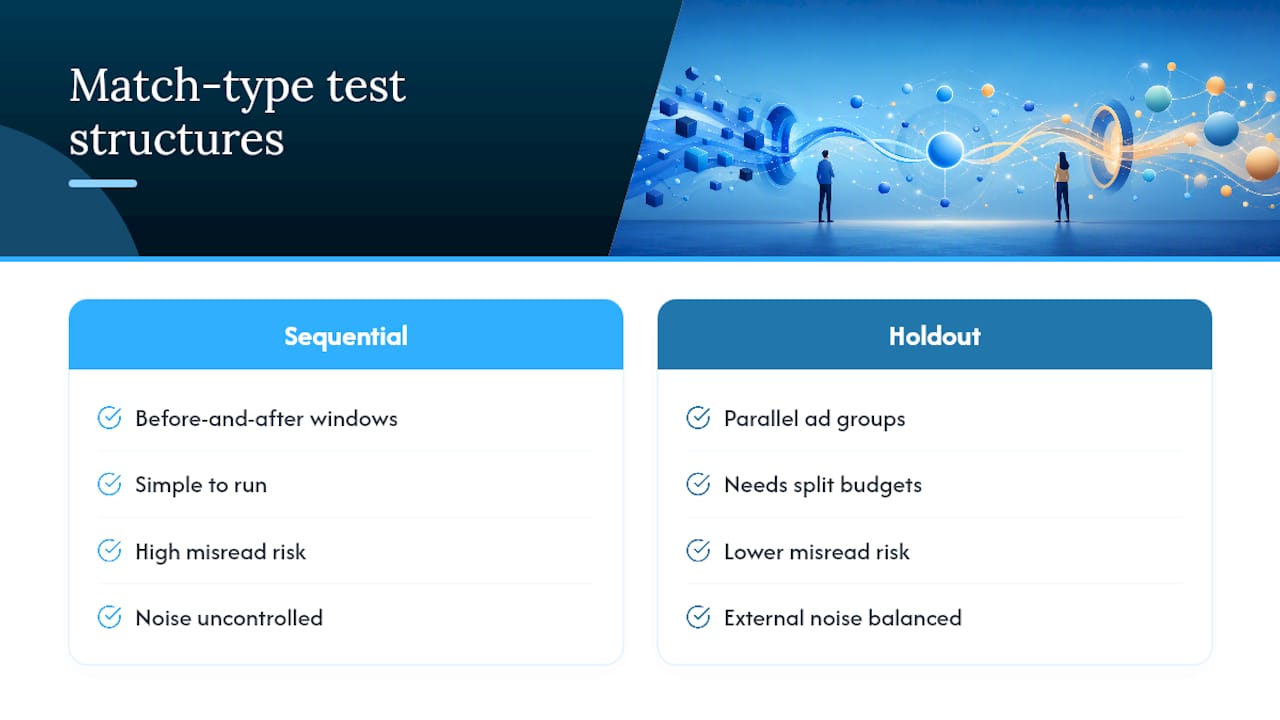
Sequential tests, where you switch match type and compare before-and-after periods, are the simplest to run but the easiest to misread if you don’t account for seasonality or a competitor’s bid change in the same window. A cleaner option is a holdout campaign structure, running phrase and broad versions of the same ad group in parallel with split budgets, so external noise hits both equally.
Track cost per acquisition, conversion rate, and value per conversion or ROAS as your primary KPIs, along with a signal-quality metric like qualified lead rate if your sales team can supply it. Search Engine Land’s analysis notes that Smart Bidding typically needs several weeks and a minimum conversion count to stabilize, and short tests often mislead because early learning-phase volatility looks like a trend when it’s just noise. Give any match-type test at least three to four weeks before drawing conclusions.
How EngageZing Applies This Framework for Clients
EngageZing’s rule of thumb: start phrase-led, then stage a broad match rollout once conversion signals mature and a real negative list exists. Before recommending broad, the Google Advertising team checks conversion tracking accuracy, monthly conversion volume, and landing page alignment for every ad group in question.
The Real Lesson Buried in the Broad vs Phrase Debate
The debate over which match type is better misses the actual variable that decides the outcome: signal quality, not keyword strategy. An account with clean conversion tracking and healthy volume can run broad match aggressively and let Smart Bidding do real work. An account without that foundation will get burned by broad match regardless of how carefully the keywords are chosen, because there’s nothing reliable for the algorithm to learn from.

Where conventional advice falls short is treating this as a preference question, “some advertisers like broad, others prefer phrase,” when it’s really a readiness question. Phrase match isn’t the cautious choice for nervous marketers. It’s the correct choice for any account whose tracking or conversion volume can’t yet support automated bidding making judgment calls on your behalf.
If you’re deciding today, audit your tracking setup before you touch your match types. Fixing a broken conversion pixel will move your numbers more than any match-type switch, and it’s the step most accounts skip because it’s less visible than a keyword change.
— Joe
Get Your Match-Type Strategy Built Right the First Time
Running broad match well takes clean conversion tracking, a mature negative list, and a bidding strategy built to use both, which is exactly where most in-house teams run out of time. Engagezing’s Google Advertising service sets up campaigns with the conversion-tracking fixes, Smart Bidding calibration, and negative keyword program described above already in place, so you’re not guessing at week three whether broad is working or leaking budget.
Every account gets a dedicated local expert who reviews your current match-type mix, tracking setup, and account structure before recommending changes, not a templated audit. If your campaigns are stuck between phrase match caution and broad match risk, get a free analysis at grow.engagezing.com and see exactly where your setup needs work before you spend another dollar testing it yourself.
Sources
- About keyword matching options - Google Ads Help
- Phrase match losing ground to broad match in Google Ads - Search Engine Land
- SearchTermMatchTypeEnum - Google Ads API reference (v24)
Recommended
Editorial Note: Content on this blog is generated with AI assistance and independently reviewed and fact-checked by human marketing professionals for accuracy and quality.